
How a Kenyan Community and a Zoo in Ohio are Strengthening Conservation Together
By Chloe Lucas
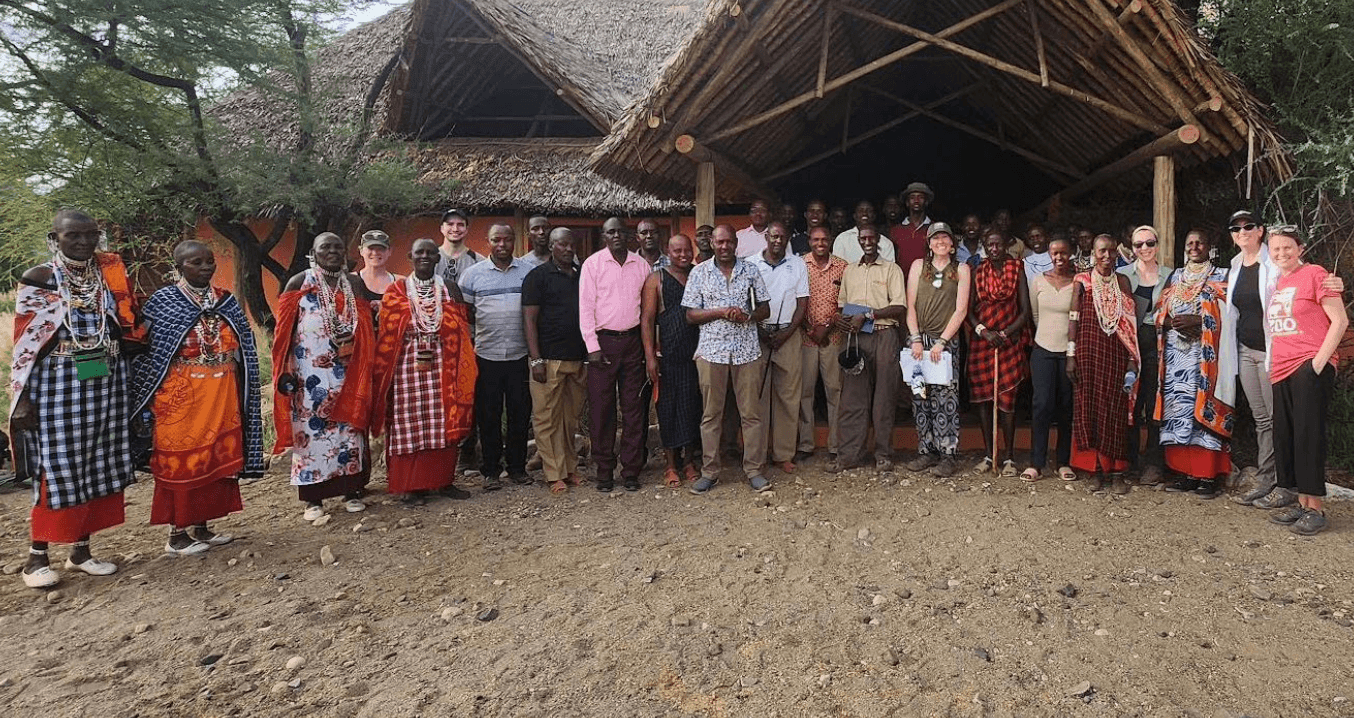
Over twenty years ago, a journey to Kenya’s Southern Rift planted a seed that would change the Cincinnati Zoo’s approach to conservation forever. During that trip, David Jenike—now the Zoo’s Director —first met John Kamanga, Co-Founder of SORALO, a community-based conservation organization representing 30 Indigenous Maasai Communities in southern Kenya. What began as a single visit grew into a partnership that has now spanned over two decades, built on radical but a simple truth: lasting conservation is fundamentally about people.
By investing in local communities for the long haul, the Cincinnati Zoo and SORALO are proving that wildlife thrives when conservation is led by the people who live and work alongside it every day.
Recently, these organizations decided to take a deeper look at their relationship. They used the ECA’s PARTNERS Principles—a framework for ethically engaging with communities for conservation—to reflect on their conservation journey together. Their results were recently published in the journal Ecological Solutions and Evidence and offer a roadmap for the future of wildlife conservation.
As a social scientist, I was thrilled to read their publication and to see the framework applied in such a meaningful way. To learn more about the evaluation process, I sat down with the Cincinnati Zoo team to discuss how the framework shaped their assessment and how their reflections might help other international organizations rethink how they may effectively support community led conservation.
For starters, I really wanted to know the single biggest lesson they had learned during their partnership. The team’s answer was immediate: Trust. In this unique partnership, trust isn’t just a “soft” concept; it’s a structural requirement. As the team explains:
“Give autonomy for community organizations and really mean it. It’s easy to say you ‘support community-led conservation,’ but it’s much harder to step back and trust partners to set the agenda, define success, and decide how funds are used.”
Having spent time with our own conservation teams apply the PARTNERS Principles, I was curious to know which of the principles felt the strongest in the relationship between Cincinnati Zoo and SORALO:
“Respect and empathy were definitely the strongest. There’s a deep, genuine respect between individuals in both organizations, and commitment to address any power dynamics. And empathy, especially during tough moments like the COVID-19 pandemic, drought, or intense human- wildlife conflict incidents, has shaped how we respond to each other.”
But building authentic partnerships requires honesty about where things are difficult. During our discussion, the team acknowledged that Presence is often the hardest principle to live up to. In professional terms, they can call these their “growth edges”— the specific areas where the organization recognizes it still has room to learn, evolve and do better.
“Being on different continents and in different time zones creates internal constraints. Staying “relationally present” – not just sending checks – takes immense effort and capacity.”
The team emphasized that they cannot be more effective if we aren’t able to reflect on and transparently share their growth edges. Despite the challenges posed by the geographical distance, what I heard from the team was that their shared vision and passion continue to drive the partnership. Exchange visits have helped to cement old relationships and allow new ones to develop.
The partnership illustrates that conservation belongs to everyone, not just scientists. For example:
• The Maintenance Team: In a recent exchange, the zoo maintenance team provided support, training and knowledge-sharing with the SORALO team on installing and maintaining solar power systems.
• Institutional Buy-in: By engaging staff in internal zoo departments such as facilities, communications, visitor engagement, and education, the zoo builds internal transparency and accountability, while decentralizing cross- organizational relationships beyond the conservation departments.
Their advice: “Don’t isolate the partnership within your conservation department. Identify leverage points across your institution – communications, education, facilities, retail, design, and finance. When staff beyond scientists are meaningfully engaged, you build internal buy-in, increase transparency, and create more relevant support. Make decisions from a place of sharing abundance”
Using the PARTNERS Principles as an evaluation tool gave the teams a moment for intentional reflection. They came away from the process feeling great pride in their partnership – and rightly so. Here were some of the reflections:
“It was powerful to hear leadership say clearly that conservation is not a project. It’s long-term, sustained work. And that funding structures need to reflect that. To be associated with an organization that openly acknowledges that, and is trying to act accordingly, was affirming.”
“I felt pride. The self-awareness I felt among some of the leaders and their willingness to name where they had growth edges showed me a leadership style
I hope to continue to emulate. We can’t be more effective if we aren’t able to reflect on and transparently share our growth edges.”
Not only do the Cincinnati Zoo and SORALO hope to continue improving their partnership, but they are also championing the PARTNERS Principles within the Association of Zoos and Aquariums (AZA) as a tool for better aligning institutional work with community voices. By doing so, the team hopes to shift the industry standard. The goal is to inspire other international organizations to be more intentional, creative, and collaborative to build more successful conservation partnerships.
It was inspiring to speak with the Cincinnati Zoo and there is so much to learn from their journey- which is far from over – far more than I could capture here. But we all hope their story inspires a shift toward conservation that truly listens to the people living alongside wildlife. By using these Principles, the Zoo and SORALO have shown that conservation isn’t just a short-term project—it’s a lifelong commitment to growing together. I highly encourage you to read the paper for more insights into the incredible work they are doing together.
About the author: Dr. Chloe Lucas is Conservation Scientist at the Snow Leopard Trust. She extends her special thanks to Bailey Cadena, Mahi Puri and David Jenike for their conversation, and the entire Cincinnati Zoo Conservation Team and their partners at SORALO for sharing their story.