Changing how Conservation is Practiced
At the National University of Mongolia, Bayarmaa Chuluunbat saw an opportunity to apply ECA’s learning to educating future conservationists. As an ECA member and training graduate, she worked with Biology Department faculty to develop Local Communities and Conservation, a lecture and seminar series that addresses a gap in the Conservation Biology curriculum.
Bayarmaa grew up in a nomadic herding family in western Mongolia. She knew how closely people’s livelihoods were connected to nature, but her conservation education focused on ecology, wildlife biology, and research methods. She learned much of what she knew about working with communities through personal experience. “We were often taught how to collect information from communities, but not necessarily how to involve them in making decisions. Looking back, I think that was an important gap.”
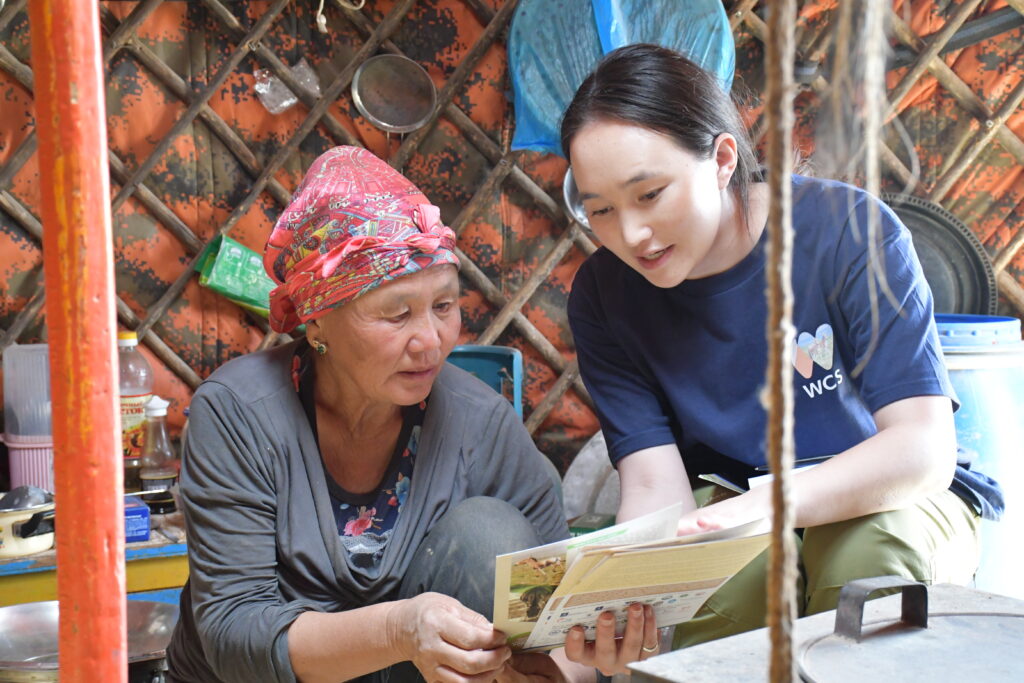 Bayarmaa with a herder. Photo credit: WCS Mongolia Bayarmaa and her colleagues adapted ECA’s trainer’s guide for Mongolian students and conservation practice. Translating the materials into Mongolian was only the beginning. Concepts such as power, participation, and decision-making needed examples students could recognize: herders sharing habitat with snow leopards, protected-area regulations affecting grazing, and researchers working with communities that hold generations of ecological knowledge.
Faculty co-facilitated trial sessions and revised the material using student feedback. ECA members Justine Alexander and Jargal Jamsranjav, along with Odonchimeg Munkhdalai, supported the effort. The two-session series received formal approval, with delivery to undergraduate and graduate students scheduled every semester beginning in fall 2025.
“I hope they will ask questions before offering solutions.” Bayarmaa wants students to introduce themselves, explain their purpose, listen to people’s concerns, and understand local priorities before deciding what should happen. A herder brings knowledge, responsibilities, and a legitimate voice in decisions affecting their land and livelihood.
Mongolia’s ranger training brought the approach into another professional setting. National ranger forums held in 2023, 2024, and 2025 gave rangers opportunities to describe the professional support they needed. At the 2024 forum, many voiced a clear request: “We now have uniforms, equipment, and gear. Now we need to develop ourselves and improve our professional skills and knowledge.”
Volunteer and community rangers specifically requested wildlife monitoring, community engagement, communication, and workplace stress management. Mongolia lacked a systematic framework to prepare rangers in interpersonal communication and personal development.
Rangers conduct regular patrols, permit checks, wildlife conflict management, and emergency responses. Even checking permits for pine-nut harvesting or wildlife hunting could lead to conflict. Local residents could see rangers as domineering outsiders, leaving them feeling isolated in their own communities. Rangers also helped with wildfires, wildlife emergencies, and tourist litter, maintaining daily relationships with the same residents whose activities they monitored.
The Ministry of Environment and Climate Change formed a working group to develop the ranger curriculum. SLCF presented the PARTNERS approach and pilot training results and proposed including it. Ministry officials agreed, and the minister approved the curriculum on 29 March 2024. Ethical community engagement became part of the intermediate-level training, alongside the program’s preparation in legal and environmental knowledge, self-defense, and other professional skills.
In pilot feedback, rangers identified a different way to approach disputes: listen and understand first, rather than immediately exert authority. Some also recognized that the tools could help them manage difficult relationships at work and at home.
With support from a KFW project, the program aims to prepare 40 master trainers; the first 20 have completed training-of-trainers. Around 50 rangers and specialists trained through a Darwin Initiative project run by SLT and SLCF could also help deliver the curriculum. The plan is to deliver nationwide to approximately 2,500 state-funded and volunteer rangers.
One ranger described what the investment in equipment and training meant at home: “As the government invests in us with equipment and training, our respect in the family and community has grown. Even kids now say, ‘I want to be a ranger like my dad.’”
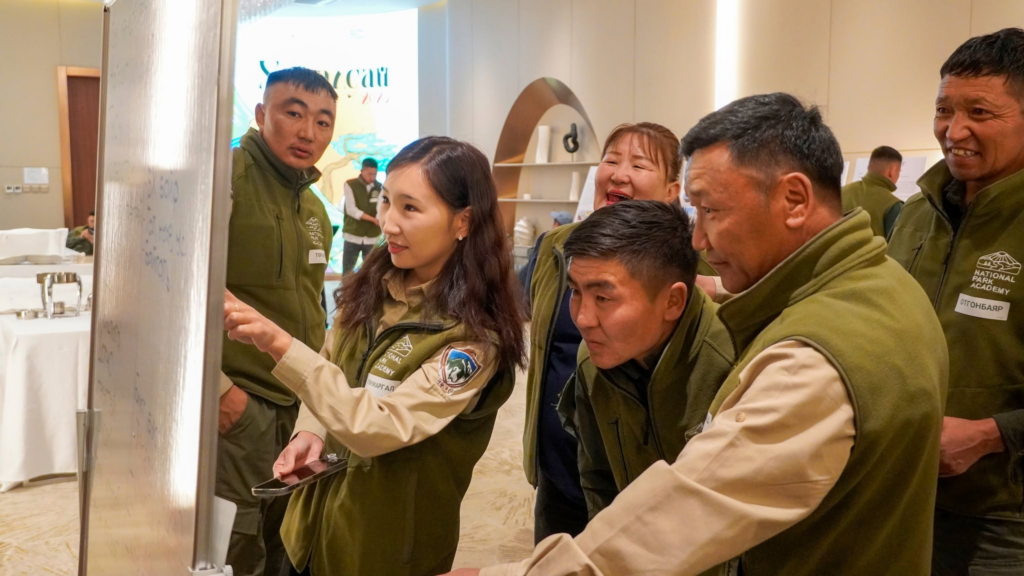 Photo credit: Temuujin Erdene-Ochir In Pakistan, Dr. Saeed Abbas led the integration of the PARTNERS Principles into a BS-level course at Karakoram International University. An ECA training graduate, he carried the approach into a setting where it could become part of students’ conservation education. Saeed also plans to extend the learning to conservation professionals and wildlife department staff.
In Mongolia and Pakistan, ECA graduates, university faculty, and government institutions are embedding the principles in professional and academic life. Members are carrying the work forward through their own institutions, adapting it to the people who will use it.
These initiatives represent an important shift: ethical community engagement is moving beyond individual workshops and becoming part of the systems that prepare conservationists for their work. From university students learning to share decision-making with communities to rangers developing new ways to navigate conflict, the PARTNERS Principles are helping connect conservation knowledge with the human relationships on which lasting conservation depends.
A young conservationist could learn about rights, relationships, power, and community engagement as routinely as ecology, statistics, and field methods. That’s the future the ECA hopes to see, and the university and ranger programs are steps toward it. The alliance’s members bring different experience to this work, from community health and wildlife relationships to teaching and knowledge sharing. They are building ways for conservationists to learn from one another and work more respectfully with the people who share land with wildlife. |


