
Patience, Trust, and the Long Road to Partnership
By Dr. Tserennadmid (Nadia) Mijiddorj
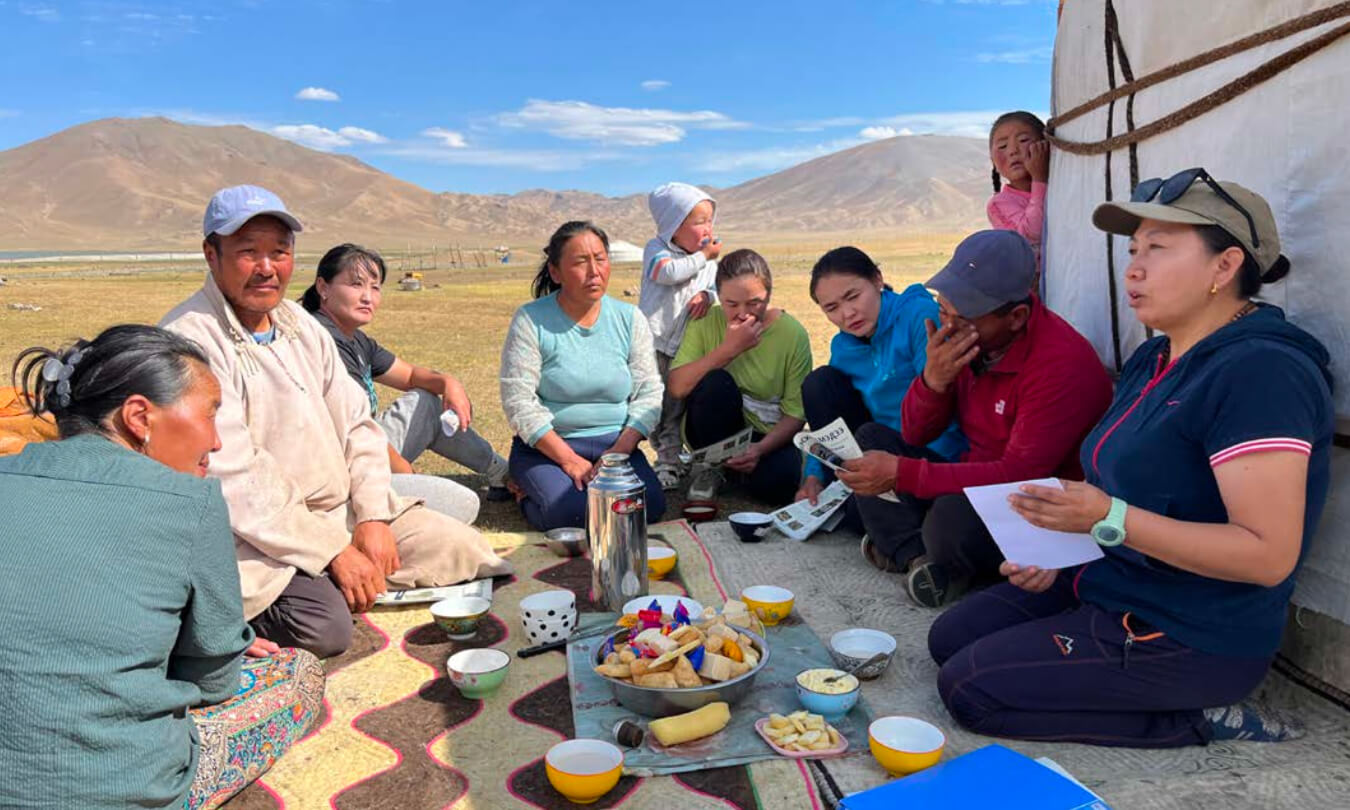
Photo credit to Nadia Mijiddorj
More than twenty years ago, when I first began working with herding communities in Mongolia’s snow leopard landscapes at the Snow Leopard Conservation Fund (SLCF), I arrived with enthusiasm, ideas, and conservation goals. We wanted to reduce threats to snow leopards, improve habitat protection, and strengthen community participation in conservation. Looking back, I realize that meaningful conservation partnerships are not built through short-term interventions but through years of patience, presence, and mutual respect.
Like most conservation practitioners, we hoped to see positive changes quickly. We organized meetings, shared information, and introduced new ideas. Sometimes communities responded with interest. Often, they did not. Some meetings ended with silence. Others took years before communities were willing to engage.
Over time, we learned an important lesson: conservation is fundamentally about relationships, and relationships develop on their own timeline.
Rather than measuring success by immediate results, we learned to value presence, consistency, and patience. We continued to visit communities year after year, sharing tea, listening to concerns, participating in local discussions, and supporting them when opportunities arose. We learned not to interpret hesitation as rejection. Instead, we reminded ourselves that positive change would happen someday, even if we could not predict when.
In many cases, communities had seen numerous projects come and go. External organizations often arrived with predetermined agendas and short project cycles, expecting rapid outcomes. Local people had learned to be cautious. Trust was not something that could be achieved through workshops or project documents. It could only be earned through long-term commitment.
As the years passed, our relationships deepened. Conversations that initially focused on livestock losses to wild carnivores or on local challenges gradually expanded to include discussions of wildlife, land stewardship, and community governance. Community members began approaching us with their own ideas and aspirations. Rather than asking how they could support our conservation objectives, they began asking how conservation could support their communities and future generations.
This shift transformed our work.
Many of the initiatives that later became central to our conservation approach, including Community Responsible Areas, community rangers, Snow Leopard Enterprises, community-based livestock insurance, and local conservation leadership, did not emerge from a predefined strategy. They evolved organically through years of dialogue, shared experiences, and mutual learning.
The same was true for what we now call the PARTNERS Principles.
The PARTNERS Principles were not developed in a meeting room or written as a theoretical framework. They emerged from experience. After years of working alongside communities, local governments, and other stakeholders, we began to recognize common patterns behind successful collaborations. The strongest partnerships were those built on mutual respect, shared decision-making, local leadership, and a genuine commitment to listen before acting.
As these ideas took shape and were eventually formalized into the PARTNERS Principles, we gained confidence that our approach was moving in the right direction. The principles did not introduce something entirely new; rather, they articulated lessons that communities had already been teaching us for many years.
Looking back, some of our most significant conservation achievements were the result of patience rather than planning. Communities that initially showed little interest in conservation later became strong advocates for snow leopard protection. Individuals who were once skeptical became community leaders, rangers, and conservation champions. Local partnerships that began with informal conversations have evolved into long-term collaborations that continue today.
This experience has reinforced a simple belief: meaningful conservation outcomes are often the result of strong relationships rather than the starting objective. When communities feel respected, heard, and supported, conservation actions emerge naturally and are far more likely to endure.
Today, as we continue to work across Mongolia’s snow leopard landscapes, we still remind ourselves of the lessons learned over two decades of partnership. We do not expect immediate positive results. We do not assume that trust can be accelerated. Instead, we remain patient, continue showing up, and believe that positive change will come in its own time.
In a world increasingly driven by short funding cycles and demands for rapid results, patience may seem old-fashioned. Yet our experience suggests that patience is not the opposite of progress. Rather, it is often the foundation upon which lasting conservation partnerships are built.
After more than twenty years of working with communities, we have come to understand that enduring conservation success depends not only on protecting wildlife and landscapes, but also on nurturing the human relationships that make such protection possible.
About the author : Dr. Tserennadmid (Nadia) Mijiddorj is the Conservation Director at Snow Leopard Conservation Foundation in Mongolia.